The Gig Workers Act Gave Him SOCSO. Nobody Told Him What That Means.
Something changed in his payout in April. A new line, a small deduction, and no explanation. The Gig Workers Act arrived. He is still working out what it means.
22 June 2026
4 min read-- reading now
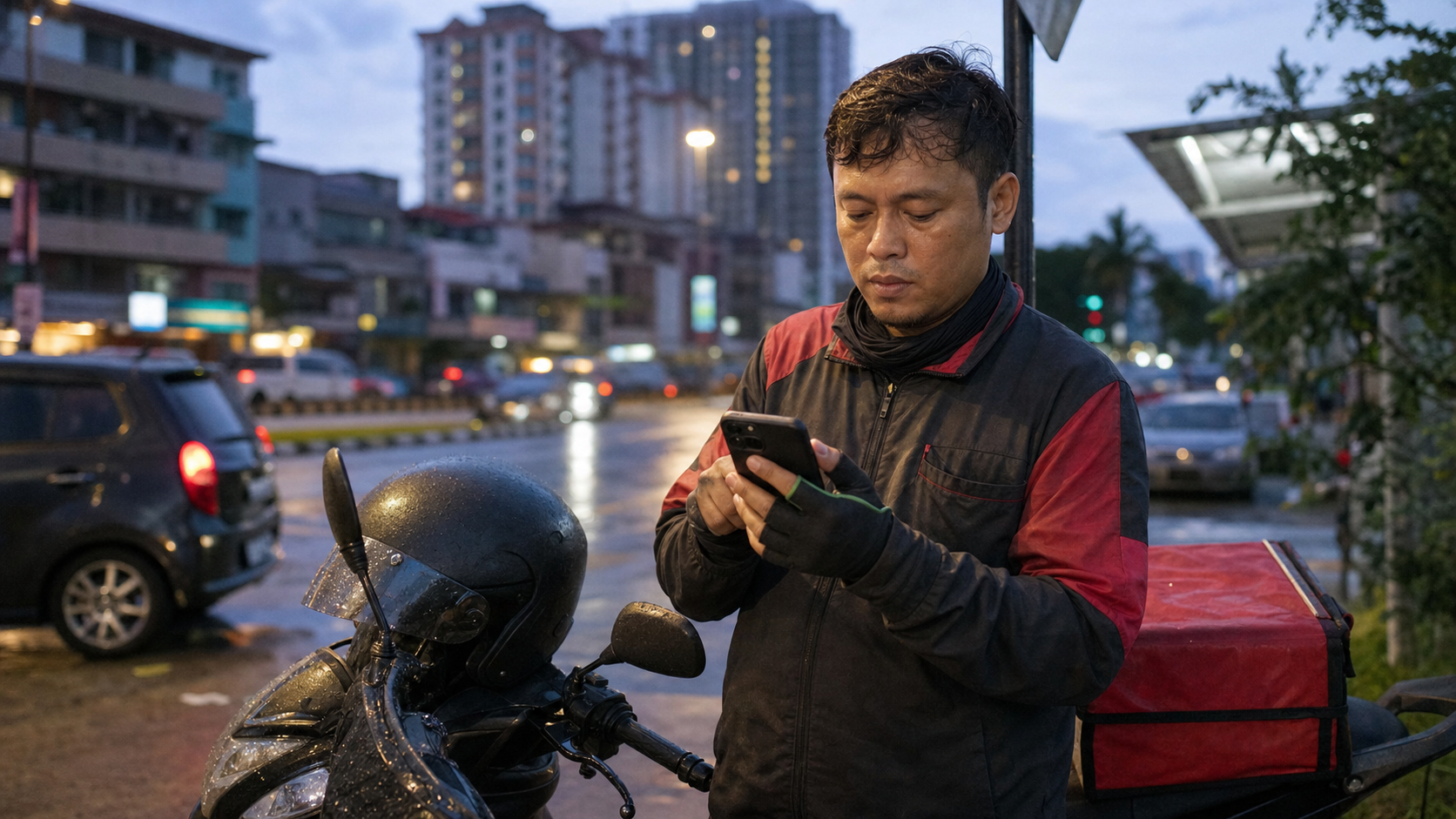
The notification came on a Tuesday. Not the kind that means a new order. The kind that sits in the earnings breakdown, a line he had not seen before.
PERKESO. A deduction. A few ringgit from the week's total. He looked at it the way most people look at unfamiliar charges: briefly, without full comprehension, before swiping to the next screen.
That was early April. The Gig Workers Act had come into force on March 31st. Among other things, it meant that platform companies were now required to deduct social security contributions from their riders' earnings and send them to PERKESO on their behalf. Mandatory. Automatic. No form to fill, no box to tick.
What it bought him, he was not entirely sure.
The Act covers 1.6 million workers across Malaysia. Ride hailing drivers. Food delivery riders. Freelancers whose work flows through a platform app. It is the first piece of Malaysian legislation to formally recognise gig workers as a category requiring legal protection. They are not employees. They are not independent contractors in the traditional sense either. They are something the law previously had no clear language for.
The protections are real. If a rider is injured during work, PERKESO now covers medical treatment, temporary disability payments at eighty per cent of average daily wages, and a permanent disability pension if it comes to that. For someone navigating Kuala Lumpur traffic on a motorcycle in June rain, none of this is theoretical. Before the Act, this coverage existed on a voluntary basis. Uptake was low. Most riders carried the full risk themselves, which meant that an accident was not only a physical event but a financial one. Sometimes a devastating one.
That part has changed. A rider who goes down on a wet road in 2026 has something beneath him that was not there a year ago.
But the law has edges, and the gaps are where the quiet costs live.
The Act does not provide an employer EPF contribution. A salaried worker earning three thousand ringgit a month receives an additional three hundred and ninety from their employer into EPF, automatically, without thinking about it. The rider receives nothing equivalent. The government's i Saraan Plus scheme offers matching contributions of up to six hundred ringgit a year for gig workers who contribute voluntarily. That is a genuine incentive. It is also a different order of magnitude. Six hundred a year against four thousand six hundred and eighty. The arithmetic is not subtle.
The Act does not provide paid leave. If a rider is sick, not injured on the job, just the ordinary kind of sick where you stay home for two days, there is no income. The app does not know he is unwell. It registers only that he is not online.
The Act mandates written service agreements between platforms and workers, and establishes a process for resolving disputes. Both matter. But written agreements describe the terms of a relationship in which the platform still sets the algorithm, the pricing, the incentive structure, and the conditions under which a rider can be suspended. The contract formalises a dynamic that remains, at its centre, asymmetric.
None of this makes the Act a failure. It is the first legislation of its kind in Malaysia, and in several respects it leads the region. The mandatory PERKESO coverage alone is a material change for people whose work involves physical risk every shift. The fact that the law recognised these workers at all, that it found language for them, is not nothing.
But there is a distance between a law being gazetted and a person knowing what it means for him. The rider who noticed the new deduction on his payout did not receive a letter explaining what it bought. There was no briefing, no orientation session, no conversation with an HR manager, because there is no HR manager. The information exists on government portals and in news articles and in threads on social media. But information that requires you to go looking for it reaches people differently than information that is handed to you at a desk.
He knows something changed. He can see it in the numbers. Whether the few ringgit a week will be there when his knee gives out on a rainy Tuesday in Cheras, and whether the claim process is something a person working twelve hour shifts can actually navigate, those are questions the Act opened but did not close.
The phone lights up. Subang Jaya to Petaling Jaya, eighteen minutes. He puts it in gear.
The safety net is there now. What he builds on top of it is still entirely his.
Notifikasi itu datang pada hari Selasa. Bukan jenis yang bermaksud pesanan baru. Jenis yang terletak dalam pecahan pendapatan, satu baris yang dia tidak pernah lihat sebelum ini.
PERKESO. Satu potongan. Beberapa ringgit daripada jumlah minggu itu. Dia memandangnya seperti kebanyakan orang memandang caj yang tidak dikenali: sebentar, tanpa pemahaman sepenuhnya, sebelum meleret ke skrin seterusnya.
Itu awal April. Akta Pekerja Gig telah berkuat kuasa pada 31 Mac. Antara lain, ini bermakna syarikat platform kini diwajibkan memotong caruman keselamatan sosial daripada pendapatan penunggang dan menghantarnya kepada PERKESO bagi pihak mereka. Wajib. Automatik. Tiada borang untuk diisi, tiada kotak untuk ditanda.
Apa yang ia beli untuknya, dia tidak sepenuhnya pasti.
Akta ini meliputi 1.6 juta pekerja di seluruh Malaysia. Pemandu perkhidmatan ehailing. Penunggang penghantaran makanan. Pekerja bebas yang kerjanya mengalir melalui aplikasi platform. Ia adalah perundangan pertama Malaysia yang secara rasmi mengiktiraf pekerja gig sebagai kategori yang memerlukan perlindungan undang-undang. Mereka bukan pekerja tetap, bukan juga kontraktor bebas dalam erti kata tradisional, tetapi sesuatu yang undang-undang sebelum ini tidak mempunyai bahasa yang jelas untuknya.
Perlindungannya nyata. Jika seorang penunggang cedera semasa bekerja, PERKESO kini menanggung rawatan perubatan, bayaran hilang upaya sementara pada kadar lapan puluh peratus daripada purata gaji harian, dan pencen hilang upaya kekal jika sampai ke tahap itu. Bagi seseorang yang mengemudi trafik Kuala Lumpur di atas motosikal dalam hujan Jun, ini bukan teori. Sebelum Akta ini, perlindungan ini wujud secara sukarela. Penyertaan rendah. Kebanyakan penunggang menanggung risiko sepenuhnya sendiri, yang bermaksud kemalangan bukan sahaja peristiwa fizikal tetapi juga peristiwa kewangan. Kadang-kadang yang memusnahkan.
Bahagian itu sudah berubah. Seorang penunggang yang terjatuh di jalan basah pada 2026 mempunyai sesuatu di bawahnya yang tidak ada setahun lalu.
Tetapi undang-undang ada tepinya, dan jurangnya adalah tempat kos yang senyap tinggal.
Akta ini tidak menyediakan caruman KWSP majikan. Seorang pekerja bergaji yang memperoleh tiga ribu ringgit sebulan menerima tambahan tiga ratus sembilan puluh daripada majikan mereka ke dalam KWSP, secara automatik, tanpa perlu memikirkannya. Penunggang tidak menerima apa-apa yang setara. Skim i Saraan Plus kerajaan menawarkan caruman sepadan sehingga enam ratus ringgit setahun untuk pekerja gig yang mencarum secara sukarela. Itu satu insentif yang tulen. Ia juga pada magnitud yang berbeza. Enam ratus setahun berbanding empat ribu enam ratus lapan puluh. Aritmetiknya tidak halus.
Akta ini tidak menyediakan cuti bergaji. Jika seorang penunggang sakit, bukan cedera semasa kerja, hanya sakit biasa di mana anda tinggal di rumah selama dua hari, tiada pendapatan. Aplikasi tidak tahu dia tidak sihat. Ia hanya mendaftar bahawa dia tidak dalam talian.
Akta ini mewajibkan perjanjian perkhidmatan bertulis antara platform dan pekerja, dan mewujudkan proses untuk menyelesaikan pertikaian. Kedua-duanya penting. Tetapi perjanjian bertulis menghuraikan terma hubungan di mana platform masih menetapkan algoritma, harga, struktur insentif, dan syarat di mana seorang penunggang boleh digantung. Kontrak itu memformalkan dinamik yang kekal, pada terasnya, tidak simetri.
Tiada satu pun daripada ini menjadikan Akta ini satu kegagalan. Ia adalah perundangan pertama seumpamanya di Malaysia, dan dalam beberapa aspek ia mendahului rantau ini. Perlindungan PERKESO wajib sahaja sudah merupakan perubahan material bagi mereka yang kerjanya melibatkan risiko fizikal setiap syif. Hakikat bahawa undang-undang mengiktiraf pekerja ini langsung, dan menemui bahasa untuk mereka. Itu bukan sesuatu yang kecil.
Tetapi ada jarak antara undang-undang diwartakan dan seseorang memahami apa maknanya baginya. Penunggang yang perasan potongan baru pada bayarannya tidak menerima surat yang menerangkan apa yang dibelinya. Tiada taklimat, tiada sesi orientasi, tiada perbualan dengan pengurus HR, kerana tiada pengurus HR. Maklumat itu wujud di portal kerajaan dan dalam artikel berita dan dalam thread di media sosial. Tetapi maklumat yang memerlukan anda mencarinya sendiri sampai kepada orang dengan cara yang berbeza daripada maklumat yang diserahkan kepada anda di meja.
Dia tahu sesuatu berubah. Dia boleh nampak dalam angka-angka itu. Sama ada beberapa ringgit seminggu itu akan ada apabila lututnya menyerah pada suatu Selasa hujan di Cheras, dan sama ada proses tuntutan boleh benar-benar dilalui oleh seseorang yang bekerja syif dua belas jam, itu persoalan yang Akta ini buka tetapi tidak tutup.
Telefon menyala. Subang Jaya ke Petaling Jaya, lapan belas minit. Dia masukkan gear.
Jaringan keselamatan sudah ada sekarang. Apa yang dia bina di atasnya masih sepenuhnya miliknya.